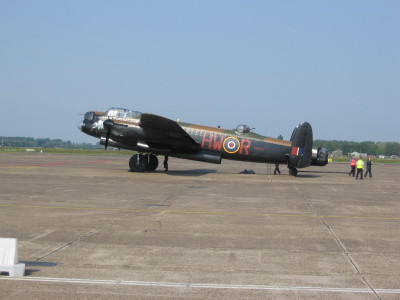
Lancaster Bomber
A Lancaster on Rotterdam Airport in 2009
Personal recollections from world war two veterans and civilians.
During this period Vic and all the other Trainees were billeted in a show ground display area sleeping on a straw filled hessian bag filled with straw and an issue of three blankets to cope with the bitterly cold. After much pleading with the authorities they were given an extra blanket.
After a number of other postings Vic arrived at No.4SFTS on 25 February 1941 only to discover there were no Ansons on the Station but this soon changed because No 8 Pilot Course soon arrived and Pilot Training commenced.
Forays into Geraldton to sample the night life, beaches and hotels was along the idea of reconnoitring this large country town as to assess the local talent (girls) but when the first Pilot Course arrived with their distinctive white flash in their caps, the available young females were greatly in demand and consequently the Ground Staff Uniform, members had much competition.
The Officer Commanding of Western Area Air Commodore D'la Rue visited the Station and let all personnel know he was there to listen to any complaint anyone had and to bring to his notice. Most Ground Staff appeared in their best blues, shoes shown to perfection and told their story. Vic was summoned from the tarmac to the Headquarters and arrived in beret and greasy overalls having moments before had been working on an aircraft engine.
After saluting this distinguished Officer he was asked to explain his complaint. Vic's was that he was not allowed to remuster to Air crew and that Flight Mechanics could not remuster to anything nor advance beyond an L.A. C. (Leading Air Craftsman). He further explained it was a dead end job.
Air Commodore D'la Rue suggested perhaps a Fitter 11E but Vic retorted that such an avenue did
not exist and he still wanted to transfer to Air Crew.
The Air Commodore said he would "look into it" Years later Vic discovered this signal had been
sent.
On 6 July 1941 Vic was posted to under go a Fitter 2E Course at No. 1 Engineering School,
located at Ascot Vale as a member of: No. 2 Fitter Conversion Course.
The wheels of bureaucracy finally moved when Vic received notification to change Mustering and enter Air Crew, a long time goal. In due time he graduated as a Pilot and was posted to the United Kingdom. There after delays finally commenced flying training at an Advance Flying Unit then followed by an Operation Training Unit, where he met up with his Crew to fly the famous Wellington Bomber.
Every member of Vic's Crew had a responsibility to develop
complete competence in their Air Crew Mustering for they all relied on
each others skill.
Vic had to pass a very Intensive AFU Course.
After may hours of flying in a great variety of weather conditions over the surrounding seas and country side, where every technical skill was assessed before moving to a Heavy Conversion Unit. There Vic was delighted to learn they would complete this last stage using the famous Lancaster, heavy, four engine bomber, which was probably the greatest aircraft of its time.
Much time was spent by the Crew in developing how to escape from the fuselage of an
old aircraft and it took some time to master what he considered an easy task. For those members,
who were with the Pilot (Flight Engineer & Bomb Aimer) had to climb over the main wing spar,
encumbered with flying gear, Mae West and parachute and its harness took a certain amount of
agility while those remaining, Wireless Air Gunner, Navigator and two Gunners needed to bail
out through the nose section. No matter how proficient they became there was no simulation of a
fire on board, or the aircraft spiralling downwards in steep turns or out of control or they being
tossed about by exploding antiaircraft shell bursting. Then there was the possibility of ditching in
the sea.
From the book "No. 4 Service Flying Training School, Geraldton, Western Australia, Pilot Training Base, 1941-1945" by Leslie R. Jubbs, 2005, which is available for download at:
http://www.futurepd.org/les/
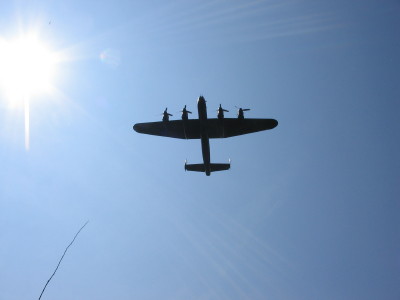
A Lancaster on Rotterdam Airport in 2009
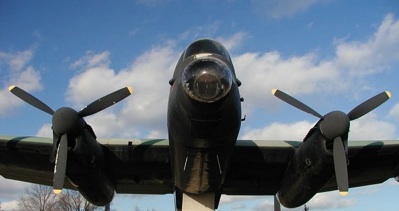
The escape hatch in the front of the bomber right after the seat of the bomb aimer.
Back to index
